

What is the thermal expansion coefficient of countertop quartz?
Jul 29, 2025
Hey there! As a countertop quartz supplier, I often get asked about the thermal expansion coefficient of countertop quartz. It's a crucial aspect that many homeowners, designers, and contractors want to know when considering quartz for their projects. So, let's dive right in and break it down.
First off, what exactly is the thermal expansion coefficient? In simple terms, it's a measure of how much a material expands or contracts when its temperature changes. Every material has its own unique thermal expansion coefficient, and this property can have a big impact on how the material performs in different environments.
When it comes to countertop quartz, it's a pretty stable material in terms of thermal expansion. Quartz countertops are made from a blend of natural quartz crystals and resins. The natural quartz itself has a relatively low thermal expansion coefficient, and when combined with the resins, the resulting material becomes even more stable.
The typical thermal expansion coefficient of countertop quartz ranges from about 5 to 10 x 10^-6 per degree Celsius. That might sound like a tiny number, but it's actually quite significant. To put it into perspective, let's compare it to some other common countertop materials.
Granite, for example, has a thermal expansion coefficient that can vary widely depending on its composition, but it generally falls in the range of 6 to 9 x 10^-6 per degree Celsius. Marble, on the other hand, has a slightly higher thermal expansion coefficient, typically around 7 to 11 x 10^-6 per degree Celsius.
So, why does the thermal expansion coefficient matter for countertop quartz? Well, it has to do with how the countertop will perform in your kitchen or bathroom. In a kitchen, for instance, you'll have hot pots and pans being placed on the countertop, and the temperature can fluctuate throughout the day. If a material has a high thermal expansion coefficient, it can expand and contract significantly with these temperature changes, which can lead to cracks, warping, or other damage over time.
With countertop quartz's relatively low thermal expansion coefficient, you can rest assured that it will handle these temperature changes much better. It's less likely to crack or warp, even when exposed to sudden temperature variations. This makes it a great choice for high-traffic areas like kitchens and bathrooms, where durability is key.
Another advantage of countertop quartz's low thermal expansion coefficient is that it allows for a more precise installation. When installing a countertop, it's important to leave a small gap around the edges to allow for some expansion and contraction. With a material that has a low thermal expansion coefficient, you can leave a smaller gap, which gives your countertop a more seamless and professional look.
Now, let's talk about some of the different types of countertop quartz we offer. We have a wide range of options to suit every style and budget. One of our popular choices is the White Quartz Black Veins. This stunning quartz features a white background with bold black veins, giving it a luxurious and elegant look. It's perfect for modern kitchens and bathrooms.
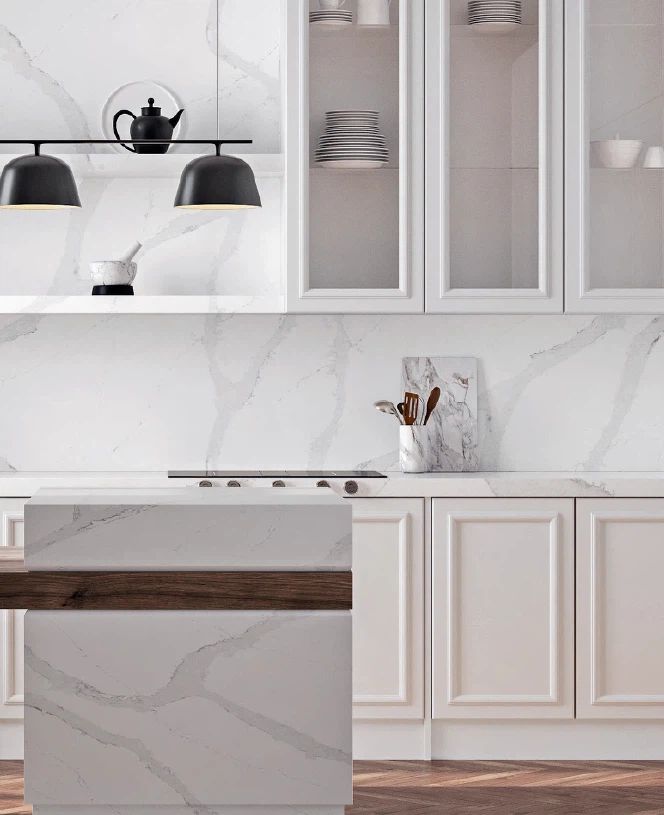
If you're looking for something a bit more traditional, our Kitchen Island White Quartz is a great option. It has a classic white finish that will complement any kitchen decor. It's also highly durable and resistant to stains and scratches, making it a practical choice for everyday use.
For those who want to make a statement, our Exotic Quartz Countertops are the way to go. These countertops feature unique patterns and colors that are sure to add a touch of personality to your space. Whether you're going for a bold and modern look or a more subtle and sophisticated style, we have an exotic quartz countertop that will fit your needs.
In addition to its low thermal expansion coefficient, countertop quartz also has many other benefits. It's non-porous, which means it doesn't absorb liquids or bacteria, making it a hygienic choice for kitchens and bathrooms. It's also easy to clean and maintain, requiring only a simple wipe-down with a mild detergent and water.
So, if you're in the market for a new countertop, I highly recommend considering countertop quartz. Its low thermal expansion coefficient, durability, and aesthetic appeal make it a top choice for homeowners and designers alike. And as a countertop quartz supplier, I'm here to help you find the perfect quartz countertop for your project.
Whether you're building a new home, renovating your kitchen or bathroom, or simply looking to upgrade your countertop, I'd love to hear from you. Feel free to reach out to me to discuss your options, get a quote, or schedule a consultation. I'm here to answer any questions you may have and guide you through the process of choosing and installing the perfect countertop quartz for your space.
Let's work together to create a beautiful and functional space that you'll love for years to come. Contact me today, and let's get started on your dream countertop project!
References

- Common Building Materials - Coefficients of Linear Thermal Expansion. The Engineering ToolBox.
- Quartz Countertops: The Ultimate Guide. HomeAdvisor.