Quartz Exterior Wall Panel
Quartz exterior wall panels are engineered stone cladding elements composed of natural quartz aggregates (90–93%) bound with high-performance unsaturated polyester resin and UV-resistant pigments.
- Fast Delievery
- Quality Assurance
- 24/7 Customer Service
Product Introduction
Quartz exterior wall panels are engineered stone cladding elements composed of natural quartz aggregates (90–93%) bound with high-performance unsaturated polyester resin and UV-resistant pigments. Produced via high-pressure vacuum vibro-compaction, these panels provide a dense, non-porous exterior surface engineered for ventilated facade systems, rainscreen applications, and direct-fix exterior wall cladding.
Unlike natural granite or marble, engineered quartz eliminates micro-fissures and inherent geological flaws, delivering predictable mechanical performance and uniform coloration across large-scale commercial building envelopes.
Technical Specifications & Compliance
Tested and certified by accredited international laboratories (e.g., SGS, Intertek), our quartz panels comply with major global architectural codes.
|
Parameter |
Standard Value |
Testing Method / Standard |
|
Composition |
93% Quartz Aggregate, 7% Resin & Pigments |
Gravimetric Analysis |
|
Panel Thickness |
12mm, 15mm, 20mm, 30mm (Custom thickness available) |
ISO 24337 |
|
Standard Dimensions |
3200×1600mm, 3000×1400mm (Cut-to-size per shop drawings) |
ISO 24337 |
|
Density |
2.35 – 2.45 g/cm³ |
EN 14617-1 |
|
Water Absorption |
≤ 0.05% |
EN 14617-1 |
|
Flexural Strength |
≥ 45 MPa |
EN 14617-2 |
|
Compressive Strength |
≥ 200 MPa |
EN 14617-15 |
|
Freeze-Thaw Resistance |
Flexural strength loss ≤ 5% after 50 cycles |
EN 12371 / EN 14617-5 |
|
Fire Classification |
Euroclass A2-s1, d0 (Non-combustible / limited combustibility) |
EN 13501-1 / ASTM E84 Class A |
|
UV Resistance |
Grade 4-5 (Blue Wool Scale, 1000 hours xenon arc) |
ISO 4892-2 |
|
Wind Load Resistance |
Tested up to 3.5 kPa (System dependent) |
ASTM E330 |
Key Product Features
Zero Water Permeability: Surface absorption rate under 0.05% prevents moisture penetration, eliminating freeze-thaw cracking, spalling, and sub-surface frost heave.
Controlled Thermal Expansion: Maintains dimensional stability across operational temperature ranges from -40°C to +80°C, reducing joint stress in rainscreen installations.
Inorganic UV Pigments: Formulated with mineral-derived pigments that resist solar radiation degradation, preventing yellowing or chromatic shift under prolonged direct sunlight.
High Load-to-Weight Ratio: Flexural strength exceeding 45 MPa allows for larger unsupported panel spans in ventilated facade sub-framing compared to traditional dimension stone.
Chemical & Atmospheric Resistance: Inert to acid rain, industrial pollutants, salt spray, and urban smog, preventing surface etching and staining.
Colors, Patterns & Surface Finishes
Surface Finishes
Polished: High-gloss reflective finish (>50 gloss units) for striking visual depth.
Honed (Matte): Low-glare, satin-smooth texture (15–20 gloss units) suitable for monolithic architectural surfaces.
Bush-Hammered / Textured: Mechanical needle-hammered face providing slip resistance, tactile depth, and light-scattering properties.
Sandblasted: Fine-grained micro-textured finish for understated urban aesthetics.
Color Series
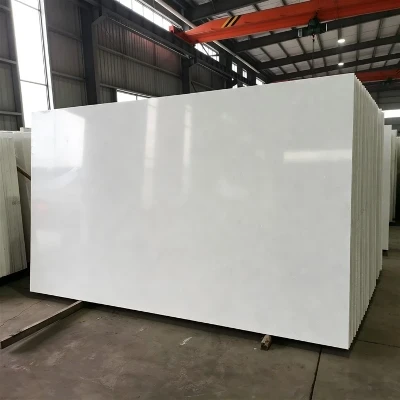
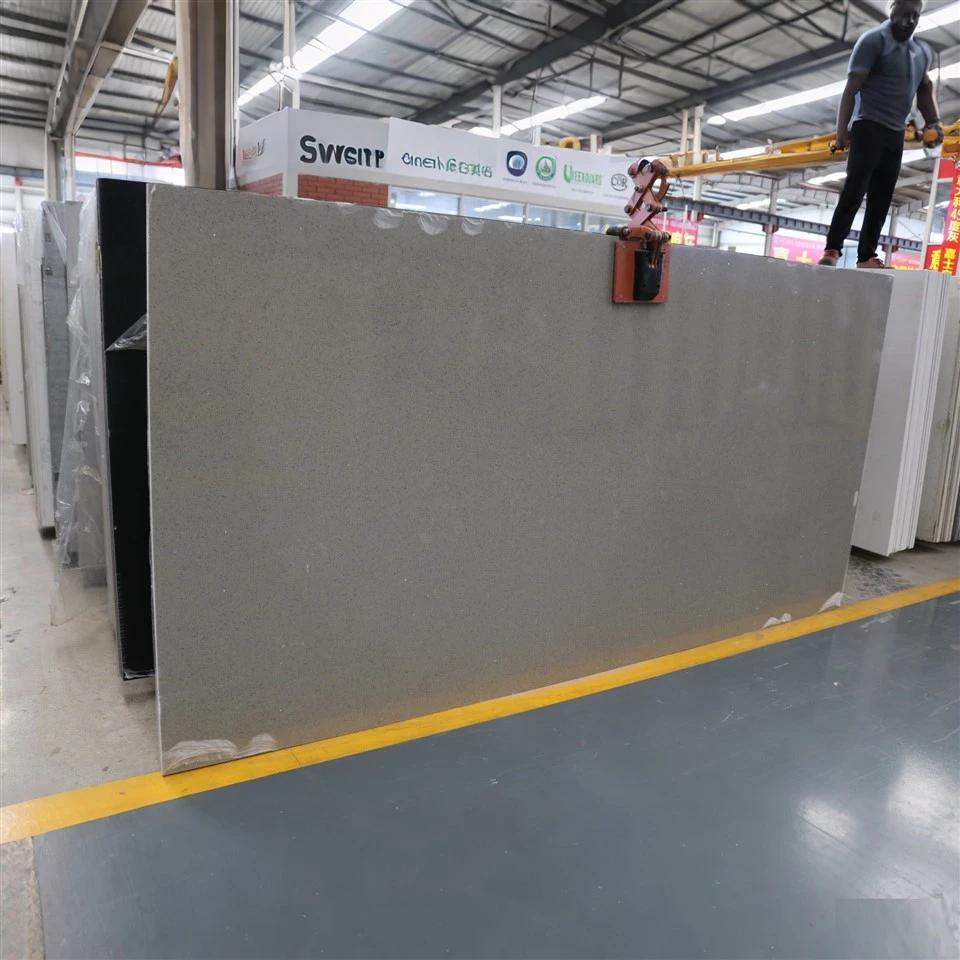
Solid Monochrome: Pure white, charcoal black, and industrial gray for minimalist facades.
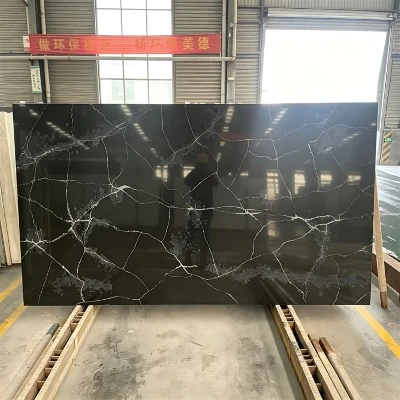
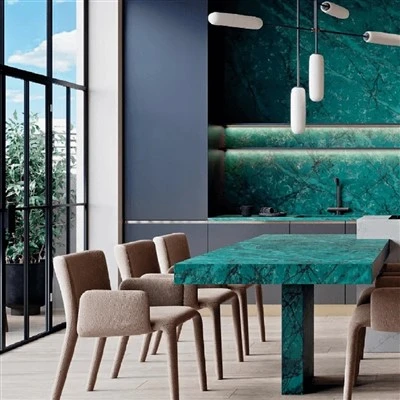
Natural Veined: Continuous marble-look directional veins passing through the entire panel thickness, preventing exposure of uncolored cores during edge profiling.
Aggregate Exposed: Custom quartz grain distributions utilizing coarse regional quartz chips for heavy industrial or civic scale.
Applications & Reference Projects
Rainscreen Ventilated Facades: Mounted via undercut anchors (e.g., Keil anchors) or visible clip systems on aluminum/stainless steel sub-frames, creating a thermal break and moisture drainage cavity.
Curterior Spandrel Panels: Non-vision glass replacement areas on high-rise commercial structures.
Column Cladding: Precision miter-folded or curved radius corner panels wrapping structural steel supports.
Exterior Soffits & Canopies: Overhead exterior applications requiring structural rigidity against wind suction forces.
Retail Storefront Portals: Heavy-traffic pedestrian ground-floor cladding resistant to impact and frequent cleaning chemicals.
OEM & ODM Customization
Precision Cut-to-Size: CNC waterjet and 5-axis bridge saw cutting based on contractor DWG/DXF shop drawings, holding dimensional tolerances within ±0.5 mm.
Edge Processing: Factory-executed beveling, rabbeting, kerf cutting for clip attachment, and blind-hole drilling for undercut mechanical anchors.
Custom Color Matching: Laboratory spectrophotometer color matching for corporate identity requirements based on RAL or Pantone physical color chips (minimum batch quantities apply).
Backside Reinforcement: Application of alkali-resistant fiberglass mesh or high-strength epoxy backing films upon request for large-format panel installations.
Manufacturing & Quality Control
Production Process
Raw Material Grading: High-purity quartz sand and granules are magnetically separated to remove iron impurities, preventing internal discoloration spots.
Batching & Dry Blending: Automated weight-cell dosing mixes aggregate fractions with resin and additives under strict vacuum conditions to eliminate air voids.
Vibro-Compression: Material is transferred into a vacuum press applying simultaneous hydraulic pressure (100+ tons) and multi-axis low-frequency vibration to achieve >99% compaction density.
Thermal Curing: Slabs undergo controlled catalytic thermal curing in a multi-stage kiln oven at 90°C–105°C to achieve complete cross-linking of the polymer matrix.
Calibrating & Finishing: Slabs cure for 48 hours before multi-head abrasive calibration, thickness leveling, and surface finishing.
Quality Control Protocols
Dimensional Inspection: Automated optical scanning measures diagonal squareness, thickness uniformity, and edge straightness on every slab.
Internal Integrity Testing: Ultrasonic pulse velocity testing detects internal micro-voids or delamination before fabrication.
Batch Retain Samples: Retained samples from each production shift are archived for 5 years for traceability and accelerated weathering audits.
Packaging & Documentation
Export Packaging: Fumigation-free vertical A-frames or horizontal heavy-duty wooden crates lined with EPE foam separation sheets to prevent transit abrasion and shock translation.
Container Loading: Secured with steel tension bands and dunnage bags inside 20-foot dry containers (maximum load limit 26,000 kg).
Documentation Package Provided:
Material Test Reports (MTR) issued by certified third-party testing labs (SGS/Intertek).
CE Declaration of Performance (DoP) / ASTM compliance sheets.
Detailed Packing Lists with individual panel QR codes linked to shop drawings.
Recommended Handling, Storing, and Installation Manual.
FAQ
Q: Can quartz exterior panels be installed using structural silicone glazing adhesives?
A: No. Due to differential thermal movement between the substrate, adhesive, and quartz panel under exterior solar exposure, mechanical fixing systems (such as undercut anchors or visible clips) must be used for exterior ventilated facade installations.
Q: What is the maximum allowable panel dimension for exterior applications?
A: Maximum recommended panel size is 3000 × 1400 mm for 20mm thickness, depending on local wind load calculations and sub-frame span limits. Exceeding this size requires engineering review.
Q: How do quartz panels behave under high winds and positive/negative pressure?
A: When engineered with appropriate thickness (15mm or 20mm) and fixed via certified sub-framing, panels withstand negative wind suction loads up to 3.5 kPa, complying with typical commercial building code requirements.
Q: Are cutouts for windows, doors, and vents done on-site or factory-machined?
A: All complex cutouts, sinkages, and anchor holes must be executed in the factory using CNC machinery prior to delivery. On-site dry cutting of engineered quartz generates respirable crystalline silica and is strictly discouraged.
Hot Tags: quartz exterior wall panel, China quartz exterior wall panel manufacturers, factory
No Information